Showing posts with label homesteading. Show all posts

Saturday, July 4, 2009

Jam and Beans


HUH? Well, yeah, here's some pics... I've been busy. We went to a U-pick place and got us a mess of strawberries. I made jam and froze a bunch. I had some rhubarb so I made some strawberry-rhubarb jam too. And can you gess what's in the three jars in front? Any guess at all? The pic isn't the best. Sorry 'bout that.


Carrot Jam! Yes, and it's wonderful! My kids love it and my wife said it reminded her of carrot cake, her favorite. It was in the Blue Book (the canner's Bible) and it sounded good... and it was.

Furthermore, I've used my canner for the first time. Remember this winter I went and bought a 23 quart canner? I finally got to use it. We got green beans in our CSA box two weeks in a row and the kids and I picked a whole mess too. Wife and kids snapped and washed 'em for me (wife capped and washed the berries too, bless her!). I got 7 quarts. I'm so happy about that. I'm hoping for more. God is good!


Thursday, February 26, 2009

The "Meat Ordeal"


This picture was entitled "Cows in the Mist". Isn't that a hoot. I like the white one. It looks like she's got shaggy hair on her poll.

But seriously. I picked up a couple of books at the library about agricultural farming and animal welfare. Now, I already knew about the horrors and maladies associated with containment animal production facilities (aka Concentrated Animal Feedlot Operations - CAFO for short), but I wanted more info.

Both of these books are well written, and the authors are activists and animal advocates in their own rights. They're also both vegetarians. In these books, I believe they are not only trying to open the readers' eyes to what goes on in feedlots all across the country, but in a way, I think they're trying to turn people into vegetarians.

I have nothing against vegetarians. As a matter of fact, my wife and I were vegetarians for awhile before we had kids. Thinnest I've ever been in my life - hmmm, maybe I should try that again (NOT!). But I believe there are different reasons for doing a thing. In this instance, I feel that the authors are vegetarians because they believe that raising of animals to be used as food is morally wrong. I, however, do not. Of course there are the health concerns. Do you KNOW where the meat in that burger you ate came from? Best not to think about it. I do most of the shopping for our family. I know the ills inherent with most of meat I buy. Even Tyson chicken, though labelled as antibiotic free, still contains traces of the stuff. But it's not enough to turn me vegetarian.

See, I realize that animals have personalities, express emotion, have intelligence to their respective degrees, can express affection or disdain. However, I feel that to give an animal the same protective status that we would give a human (less and less these days), is wrong. Why? Because humans are the only creatures God breathed life into and gave a soul to. That makes us special, unique, different.

Now believe me, I think the kind of life 90% the meat animals in this country live is awful. CAFO's are a bane to health, environment, and economy. I believe that if you have animals you're raising for food, you are obligated by the Biblical mandate to have dominion over the Earth, to not abuse what you've been entrusted with. Meaning, you should do all you can to ensure that your animals live healthy lives with as much access to sunshine, fresh pasture, clean and safe housing, and plenty of room to move around, as is within your ability to provide it. So that when the time comes to "Say goodnight, Ruthie" and put the chickens in the freezer, not only will they be healthier to eat because of the life they lived, but they will not be full of stress hormones to taint their meat. Further, you can do your butchering knowing that you aren't just taking life from the birds, but that you also gave them a good life in the process.

So what does this mean to me? Well, my wife still isn't a big fan of red meat. My daughter has also periodically shown some distaste for it as well. So really, I should probably look at ways of cutting it out of my diet a little more. I do have sources for grass-fed beef and pastured chicken. Both, however, tend to be a bit on the expensive side. I suppose if I cut the meat intake down to only a couple of times a week max, then it would be more economically viable. These are some of the reasons I want a place in the country. To raise my own food.

To cut the meat intake down will take some planning and forethought. Beans, rice, veggie stir fry, quiches, pastas - these can be done fairly easily without meat. And really, ground beef is about the only red meat we eat. Once in a while I'll buy a roast or stew meat. But I don't think my kids have ever had a steak. Maybe this is doable after all. Especially if I can and freeze more veggies this year. I'll let you know how it goes. Your thoughts?

Thursday, February 19, 2009

Last Year's Food


My homepage is set to Yahoo! Sometimes it kills me what they think is news, but the site does offer some interesting blurbs, periodically. So recently, I opened a link to a Yahoo! Money news article that said, "Americans' lower standard of living may be permanent." Like that's a bad thing or something. We all need to live more within our means, myself included.

Here's the crux of what they were saying... Retailers are having fits. People just aren't buying things like they used to. When they go to the mall, they aren't going home with three $100 pairs of shoes. Nor are they buying the $150 torn and faded blue jeans (I never understood that to begin with). No, rather, consumers are basically concerned now with just covering themselves (barely, sometimes). You can wear last year's clothes. Consumers are spending their money not on clothes, but on food, especially as prices continue to rise. The comment was, "You can't eat last year's food." WHHAAATT?

Ok, well, hmm. I'll concede that I understand what they were 'trying' to say. But just barely. Really, it's not a true statement at all. Obviously Mr. Money-Analyst person who made this comment is one of the millions of Americans that couldn't feed themselves for a year if the grocery store closed for good tomorrow. Fact is, you CAN eat last year's food.
This is what I'm saying, people. We Americans are so stinking spoiled that we have become soft and have forgotten many of the basic skills our parents and grandparents took for granted. Why'd they take them for granted? Because they were such a common part of their existence.

Wanna eat last year's food? Plant a garden, go to a farmer's market, join a CSA, whatever, but learn to can and 'put up', or 'put by' your food. Yes, it takes time, equipment, and some know how. But you can acquire all three pretty easily if you put your mind to it and make it a priority.

I don't have a pressure canner. It's something I want and will probably get in the next few years. But I still preserve food. I have a dehydrator and a water bath canner. Water-bath canning is so easy it's almost unfair. Why more people don't do it can only be attributed to the ease with which we can go to the store and buy food already canned or preserved. Or laziness. But the idea is to save money and not pay so much for what you eat. You can use water-bath canning for pretty much any type of fruit jam or jelly, applesauce, tomato products (as long as you don't add so many other ingredients that it lowers the acid level), pickles of all kinds (carrots are good, and I've heard green beans are too). There's a lot you can do.

I have a hard time not being down and gloomy as it is, without making dire predictions about our country's economic future. But I truly believe it'll get worse. A lot worse. Don't be caught feeling the crunch between paying bills and buying food. Think about what you can do, make phone calls, ask around, read books... find out where the good food is or how to grow it, then learn to preserve it. The "Ball Blue Book" is probably one of the best places to start. Go to your local library and search for food preservation. There's likely more there than you care to look at. Search yard sales this spring and look for jars, canners, supplies. You may get a real deal. Ask older relatives or neighbors for advice or instruction on canning. Truly, the most valuable people in our nation in coming days may be those of us with this kind of knowledge. We'll be surviving and have to help everyone else out.

A final note about dehydrating. there are many different ways to dry foods. My wife bought me my Nesco dehydrator as an anniversary present last year. Nothing says "I love ya, honey" like homemade beef jerky. But something very worth trying: Dried Watermelon. Seriously. Cut it up into thin strips or chunks, take the seed out and dry it. It comes out like chewy fruit leather, and wow is it sweet! You'd think it had soaked in sugar. My kids loved it. No additives or preservatives. Just watermelon. Amazing!

Wednesday, February 4, 2009

Lessons from a Farm


This is my most recent 'finished reading' book. The author is Jerry Apps, published by Voyageur Press, 2005. I read this on recommendation of The Deliberate Agrarian, Herrick Kimball, and I'm glad I did.

Mr. Apps recounts his life growing up on the family farm in the little community of Chain O' Lakes, Wisconsin (Near the village of Wild Rose), back in the 1930's through 50's. He recounts many of the daily and yearly chores that marked life and made it good. On several occasions, he laments the purchase of 'new' technology that made life easier, like an automatic milking machine, a television set, a corn binder/thresher. He laments these things because they heralded the end of a way of life, one where people came together, shared their lives, knew each other, and had real community. Each chapter is prefaced with an excerpt from his mother's money ledger, the excerpts introducing the subject of the chapter.

In this wonderful little 223 page book, we look back into the real life of an early American farm family. We share the joys of getting electricity in the house, of a good grain harvest, we get a small taste of sweat and toil of everyday life, and we hear some of the heartbreak that was as much a part of life then as it is today.

But I want this to be more than a book report (sorry if it's gotten boring). In the chapter called 'Windstorm', we're told of the spring of 1950 when a windstorm like no other blew through and literally took the barn off it's foundations. The milk cows had to be moved to a neighboring farm for several weeks while the barn was repaired. Unfortunately, the cows acquired brucellosis, or Bang's disease, while there and had to be sent to slaughter. These two calamities made life very difficult for the Apps family for some time after. The strawberry and cucumber patches were expanded to help provide a little more income until the new cow herd was up to full size and production. What struck me most profoundly out of all the book was what Mr. Apps says next:

"There was little complaining about the hard work or reduced income. Without saying anything, Pa convinced me and my brothers, through his actions, that the family had to work together as a team if we were to survive these hard times. Each of us, without bragging or talking about it, was proud to help; each of us knew our contribution was important to the farm's survival. Those years brought our family as close together as it had ever been." (p. 200-201)

Ok, some lessons... First of all, most families today aren't playing as a team, shucks, the members aren't even playing the same game. Second, it's the onus of the father to show the way. That's how it is with most things... faith, work, family.

I've often wondered recently, with economics being what they are, if things got worse, would people be as resourceful as they were back during the Great Depression? I'm not so sure. First, things would have to get so much worse than they are before people seriously start thinking about alternative means of survival (gardening, chickens, doing without, etc.). But I'm just not sure that many of today's families have the basic fabric fabric necessary to hold together and pull through. I think we're too soft, too accustomed to creature comforts that we'd just about die without our cable or internet (when was the last time you actually wrote a letter - you know, with paper- and mailed it to someone? I know I can't remember when. It's a lost art). This is just a side comment though. But I'd be interested in knowing what you think.

The big lesson to me is the responsibility that is mine. Oh, I've known about it, but this little book just kinda brings it home again. If my kids are going to learn the intrinsic value of contributing to the family economy with their work and effort, I'll have to lead the way and teach them. Not an easy task when the human nature desires to avoid work and difficulty, if you call hoeing a garden a difficulty -which it certainly can be.

The other lesson is more about the work part. Hard work. Some things aren't so hard, like hoeing the garden. That's just monotonous. But there are days when work has to be done whether you want to do it or not. A lot of folks don't know hard work. I wonder if I do. Will I/do I have what it takes to tackle hard work? I've worked hard before, but will I pass that on to my kids?

Here's the really personal part. I can take this little challenge one of two ways. I can look at it as a positive encouragement and run with it, and/or I can see it as 'one more thing' that I'll probably not do to well with and give up. I can be quite pessimistic at times, but I'm not as bad as I used to be. So I'll likely take both approaches, depending on the day and my mood. Being a father is a never ending job. The good thing is that I don't have any crazy notions of being the perfect dad - I screwed that up LONG ago. I'll settle for being as good as I can be, and if that earns me a 'great dad' once in awhile, all the better.

Sunday, January 11, 2009

A Little Contradiction?

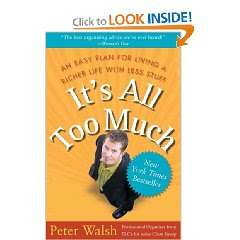
I recently ordered two books on Amazon. One I'd read about on a Homesteading site or in a magazine somewhere. The other, I saw at a Barnes & Noble recently. They both came to the house within days of each other, and both ended up on our coffee table side-by-side.

The result was somewhat humorous.......


HA HA HA HA! Ok, what gives? Well, the first book, "The 'Have More' Plan" is a book that was written back in the 50's (I believe) by Mr. and Mrs. Robinson, a couple that left the noise and pollution of New York City for a life in the country. It was their effort to educate others and help people see what kind of life there was to be had in living in the country. If you can get past the dated pictures and weed through the bad advice (like using DDT laced pesticides on your garden, or battery raising chickens), it's not a bad book at all. The Robinsons were actually recommending a life of country living, aka homesteading, as being a life where you could 'have more'. Not more in terms of cars, house, clothes... wealth as defined by culture. But rather, a wealth defined by hard work, good food, clean air, family, and self-reliance.

The second book, by Peter Walsh of TLC Channel fame, is his take on regaining control of your 'stuff'. This isn't another "how-to-organize-you-closet-in-fourteen-easy steps" book. His whole premise is that our culture has become one of 'stuff acquisition' to the point that our stuff now owns us rather than the other way around. People's lives are falling apart due, in large part according to Peter, to their homes being out of control. The one place they should be able to go to recuperate, recharge, and regain some sense of themselves is so full of junk, they can't think straight. He doesn't talk about how to store things. He talks about getting rid of things. Cleaning up, clearing out, mastering the stuff. He looks at the reasons behind why we keep all the things we don't think we can part with, and challenges us to make hard choices.

Well, even before I got the book, something in me snapped. I started cleaning out. (Which did help my mood a bit- see the previous post). I went through all kinds of stuff and took tubs of papers, catalogs, magazines, household stuff, nonsense... all to the recycle center or Goodwill. Our computer desk is actually cleared off and doesn't look a wreck. Melora has room for her school books on the shelves, my sock drawer isn't so full I can barely shut it, and our kitchen is a lot more empty of plastic containers.

Well, the two books do look rather contradictory sitting next to each other. But when you know what they're both talking about, they're not too far off from each other. In their own ways, they both seem to say, "Less is More"!

Thursday, January 1, 2009

Slouching Away From Prosperity: Dan's Perspective, Part 3


Well, here it is, part 3. If you've read the first two parts at all, I commend you. There are other people out there, writing much better stuff on the subject than I. But then again, they aren't writing my perspective, now are they?

Herrick Kimball, a blogger I follow and admire, recently wrote yet another post on the economy and how he sees the nation moving toward a more agrarian lifestyle (read it here). I like what he says, and tend to agree with him.

The point of it all is this. Our economy is broken. And I'm sorry, but anyone who thinks our new President Elect can fix it is delusional. John McCain couldn't have fixed it either (just to be fair). If people are going to weather the coming fury of the storm already broken upon us, we're going to have to learn to live differently than we do.

Back in the 40's, the victory garden was the thing to do. Scrap metal drives, rubber drives.... all early recycling (and we thought it was 'new', it's actually 'vintage' - which may be why recycling is all the rage). Thing is, our country seems to have lost some of its identity, some of its solidarity, purpose of being. We've become a nation of self-centered people and the idea of doing something because our nation needs us to is a little out of fashion. Of course, providing food for your family and yourself is never out of fashion, nor is it really a national 'need' - rather a personal need. But I wonder how many people will actually decide they need to get their hands dirty and plant a garden?

You see, there's something to be said for self-sufficiency. Actually, I prefer to call it God-sufficiency, because I recognize that everything I have is from Him. That's what I like about homesteading. In the process of living the self-sufficient life, you develop a sense of security. Regardless of what happens in the economy, you know you can provide for your family - to whatever degree you homestead. So just what is homesteading?

Well, it's hard to define. Wikipedia defines it as a lifestyle of simple, agrarian self-sufficiency. Well, there's three words in that sentence that beg further definition... A favorite publication of mine, Mother Earth News, defines it thus: "Sometimes we struggle to define the meaning of “homestead” in today’s world. For our purposes, we’ve decided to define the homestead as any home that provides an example of sustainability and beauty, whether it’s a Chicago loft powered by solar panels, a Santa Fe suburban solar home or a straw bale cottage on the Kansas prairie. Many of them raise some of their own food and generate some of their own energy. Some of them are self-sufficient. Some of them are beautiful. All of them, by our definition, are inspiring."

To me, homesteading is the art, mindset, decision, process (all of these) of working toward providing for yourself and your family in such a way as to improve your environment where possible, or at least leave as small a footprint as possible. Now before you think I've gone all 'tree-hugger' let me just say that as yet at my house, there's more of the 'leave the smallest footprint' going on than there is 'improve your environment'. But what I want to emphasize is that anyone can be a homesteader! You don't have to live in the country on 40 acres (or even 5), or have a root cellar, or use an outhouse, or grow solar panels on your roof, or drive a water powered car, or wear hemp clothes. An apartment dweller can homestead by buying up quantities of veggies at a farmer's market or joining a CSA and learning to preserve them. A suburbanite can plant a small garden if only for those few crops they use most often (ie. tomatoes, onions, corn, etc.). We can all turn our thermostats down a little, ours sits at 69 in the winter and 75 in the summer when we actually use air-conditioning (and my wife says that's cold!). Again, laundry on a clothesline can save a lot of money in electricity. It's basically just finding ways to rely less on other people to provide your needs, and rely more on yourself.

Can you read a book? You can learn to garden. Can you surf the net? You can learn to preserve food. Can you push a broom? You can use a hoe and spade. My list of examples is small and probably not very good at inspiring people to think outside the box. But the ways of self-sufficiency are limitless. It takes a change of mind, heart, and attitude... and a little economic hardship might not hurt either.

I'm struck my something that recently happened. Someone I know bought a new home. It's not far from where they previously lived. Their family didn't outgrow the old house, neighborhood was fine, same school district. But they'd been looking at homes off and on for years now. There are three people in the family. They bought a 2500 sq. ft. home with a 3 car garage and a full basement. I don't begrudge them. It's a beautiful home and I'm very happy for them. I just don't understand it. It's a difference in mind-set, I guess.

Well, I don't know what all my rambling might spark in you. But hopefully it gets you thinking about ways you could change your lifestyle and do more for yourself. If for no other reason than economics - a lot of homesteading activities will save you money!

So here are some websites to check out that will give you more than you knew existed in terms of ideas, tips, encouragement, etc. to homesteading:

Mother Earth News

GRIT

Homestead.org

Backwoods Home

Take a gander at those... that should keep you busy.

Happy Homesteading!